

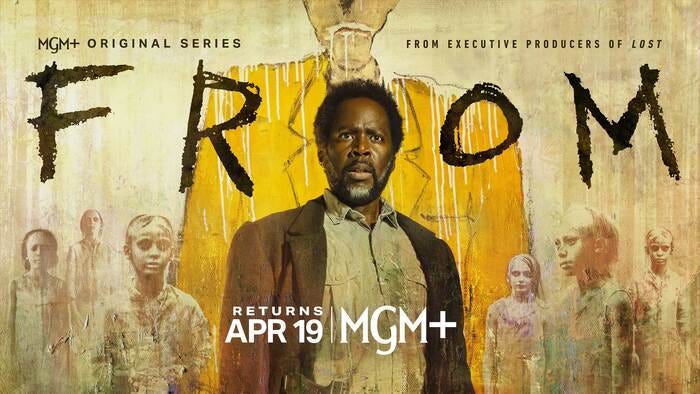
FROM on MGM+ returns Sunday, April 19, in all of its psychologically intense glory. This season will dive deeper into the mystery of “Middle America,” unraveling secrets of the land within the escalating dread of every nightfall.
[UPDATE]
On April 15, the executives and creators of FROM made a joint announcement that the series is renewed for its fifth and final season—a plan that was always written now confirmed, with the final season returning in 2027. What does this mean for fans?
No more long wait!
The answers we all seek are closer as we continue to uncover the secrets of this cursed land.
Additionally, on April 16, the official Rotten Tomatoes score for Season 4 is 100%, the second consecutive highest RT rating, and an overall 97% series score.
As one of the most talked about horror series, FROM continues to excel in blending mystery, menace, psychological terror, and fan-driven theory into an experience unlike anything else on TV or streaming.
The show is created by John Griffin and stars Harold Perrineau, Catalina Sandino Moreno, David Alpay, Elizabeth Saunders, Scott McCord, Ricky He, Corteon Moore, and Chloe Van Landschoot—who serve as key decision-makers by providing food, resources, health, and safety for the population.
And in Season 4, the strength of every single one of them may be the key to survival, and without one, everyone might fall.
Additional Cast/Episode Guide
Additional cast includes Pegah Ghafoori, Hannah Cheramy, Simon Webster, Nathan D. Simmons, Kaelen Ohm, Angela Moore, A.J. Simmons, Deborah Grover, and newcomer Julia Doyle.
Episode 1 “The Arrival”
Episode 2 “Fray”
Episode 3 “Merrily We Go”
Episode 4 “Of Myths and Monsters”
Episode 5 “What a Long Strange Trip It’s Been”
Episode 6 “The Heart Is a Lonely Hunter”
Episode 7 “Best Laid Plans”
Episode 8 “Heavy is the Head”
Episode 9 “The Calm Before”
Episode 10 “If a Tree Falls in the Forest…”
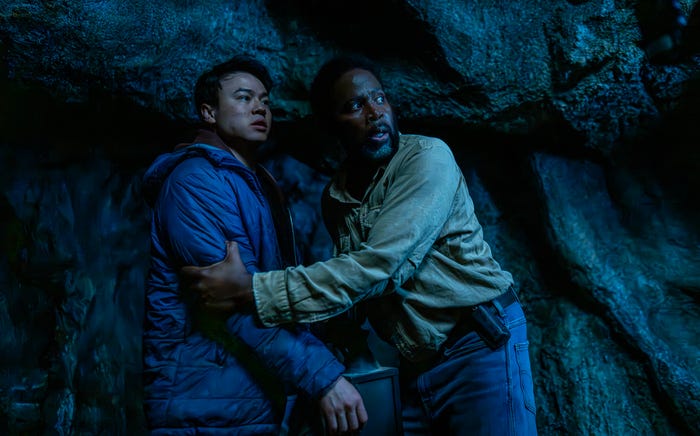
Let the True Nightmare Begin
There is something familiar yet eerily different about FROM Season 4. Not just in pace and tone, but in increased stakes that mark an escalation from the events of Season 3.
Everything changed.
And since the beginning, the series makes it clear that the audience, and the characters, will never know a moment’s peace. This is not done through exposition but through feeling and tension—an unease that burrows in your bones like a parasite looking to take root and thrive off your terror.
Season 4 feels like the beginning of the end
As the series continues its nightmarish story, one truth becomes undeniable. Not just that knowledge comes at a cost, but the more they learn, the more dangerous everything becomes. This plotline is anchored in the infamous saying “ignorance is bliss,” and for Boyd, Tabitha, and Jade specifically, it feels that pretending to not know what they know may be the thing that keeps them alive.
But to what extent?
Survival?
Or is the risk of fighting back worth the lives that will be lost in the frenzied impatience to go back home?


The Devil You Think You Know
That is the beauty of FROM: it takes philosophical lessons and twists them, turning them into indescribable horrors that drag viewers down a well with no clear and obvious end.
And in this downfall, FROM leaves clues, answers, and pieces of the puzzle both in plain sight and within the details. This level of complex storytelling makes the series more immersive and interactive—fans sleuthing like Jade to figure out the path to escape before the characters figure it out themselves.
Season 4 deepens that experience by raising the stakes beyond mere survival.
It’s about consequence.
This season feels like Season 1 but scarier—as the main characters dig for more answers, the town puts up a vicious offensive that is increasingly dangerous for those who dare to push back.
And that is where the true horror lies.
Not in what’s happening.
But why it’s happening now.


Performances That Leave You Undone
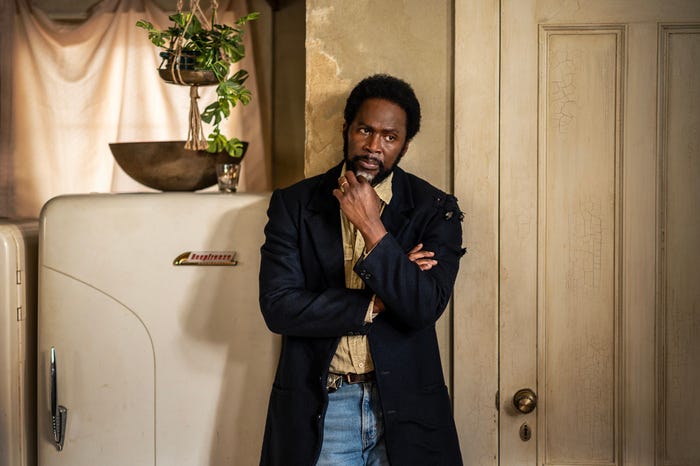
At the center of the series is Boyd, played by Harold Perrineau.
Boyd continues to be the emotional anchor of the series, and Perrineau delivers a performance that is raw, layered, and broken. The weight of leadership, loss, and responsibility bestowed upon him by the townspeople traps him in a cycle of guilt that is almost unbearable—yet he keeps going. This caliber of performance makes you root for him, his rights and his wrongs, as he tries to get everyone “the f— outta here.”
Two other performances that had a powerful impact amongst the FROMily last season are from Scott McCord and Robert Joy as Victor and Henry.
Their dynamic brings something rare to a show this destructive: tenderness. The chemistry as father and son adds an emotional depth to the series that shines a bright light through the chaos—delivering scene-stealing performances that will be discussed beyond the lifetime of the show.
Related Content
Burning Questions That Demand Answers
As we enter Season 4, there are just three burning questions that demand attention above all others:
What is the true nature of the force controlling this place—and what does it want?
How are time, memory, and reincarnation connected to the characters’ past and present nightmare?
Is mere survival the only solution, or do they actually have a chance to escape?
The answers may very well lie in plain sight. If so, be sure to not skip a single title card or discard anything shown on screen as insignificant.
If there is one thing FROM has taught us and continues to teach us, it’s that everything matters.
Every image.
Every sound.
Every life.
And every consequence.
Final Review
FROM Season 4 is a 10 out of 10 must-watch. Not because it gives you answers. But because it makes you chase them as if your very life depends on it.
But be careful.
The more you chase, the deeper you will fall.
FROM Season 4 premieres Sunday, April 19, on MGM+. Check out the trailer below.
© Kivonshe | So There’s That
Original editorial commentary on film and television. All rights reserved. Reproduction or redistribution without attribution is not permitted.
FROM: SECRETS OF THE NARRATIVE SWAMP
The structure doesn’t collapse under the weight of the mystery; it collapses because tension building and time wasting were mistaken for the same craft. By the midpoint of Season 3, the dialogue stops moving the plot and starts simulating motion.
I. The Real World vs. PR’s Rose‑Tinted Glasses
The platform’s 85–95% performance is a closed‑loop projection. Actual viewer satisfaction sits at 68–72%. The audience remains only because the Sunk Cost Fallacy keeps the door locked from the inside. Behind the IMDb 7.5–7.8 stands a fatigued base; half the viewers already feel the narrative fabric tearing.
II. DIAGNOSIS: REDUNDANCY
The S3E5 conference‑room scene is a textbook collapse: twenty minutes of dialogue with zero forward motion. The Ellis–Fatima conflicts across S3E3–S3E5 no longer build character; they erode patience. Viewers aren’t invested in their fate anymore; they’re already making a mental list of who needs to be removed so the playground can finally shut off the lights.
III. NARRATIVE STALL POINTS
The primary offense is artificially withheld information. In S2E4, Tabitha’s silence isn’t mystique; it’s narrative execution. The empty exchanges and exposition pressure from S3E6–S3E8 complete the dismantling and drain the content dry.
VERDICT
The narrative architecture is cracking. The dead air has produced a 35–45% failure risk. If Season 4 refuses to abandon static scenes, the series will flatten into an overstretched Pilates band.
Stable continuation: 60% (the loyal base keeps the lights on)
Slow decline: 25–30% (if redundancy remains the operating principle)
Failure risk: 35–45% (the cumulative effect of structural errors)
If the show clings to its current narrative habits, the failure probability reaches 75% by the end of Season 4.
If the mysteries finally begin to resolve, the failure risk drops to 10–15%.
© 2026 [TEFYTI]. All rights reserved