

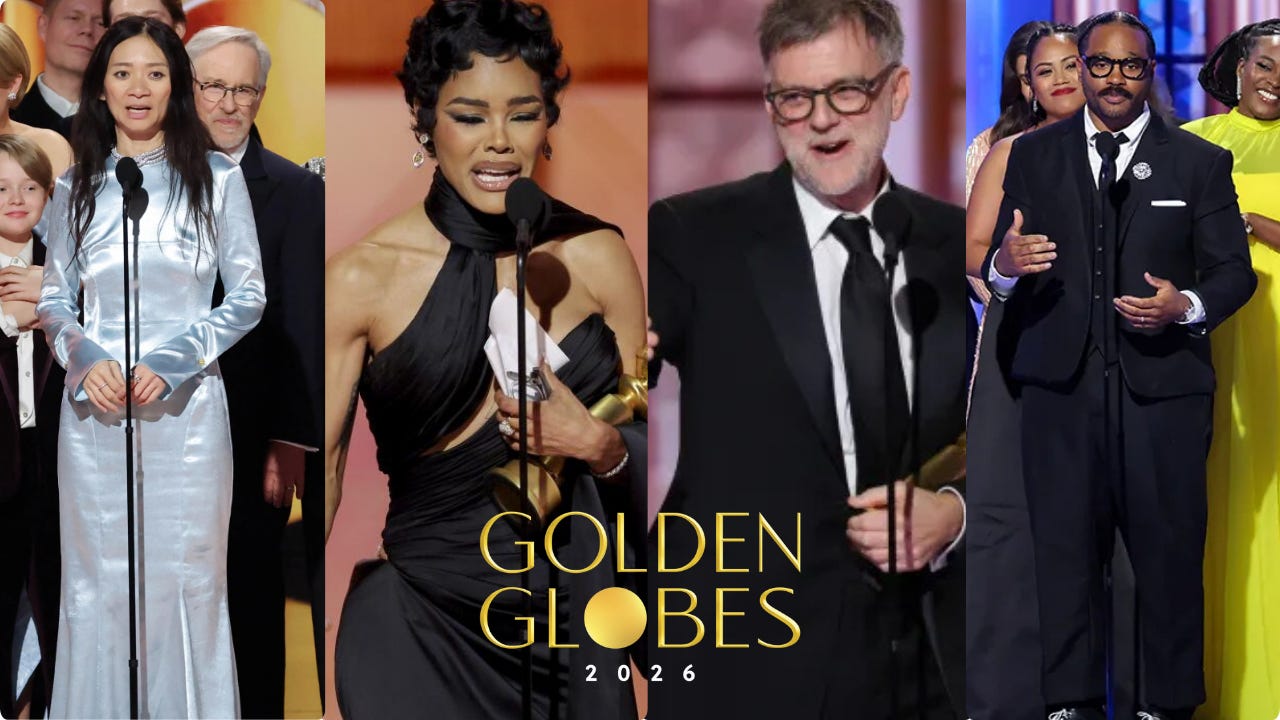
The Golden Globes have always existed in that in-between space—part industry barometer, part chaotic dinner party, part oracle reading whose moments may or may not predict anything. Sunday night, January 11, leaned fully into that tradition, delivering highly-anticipated wins, a few eyebrow-raising choices, and enough conversation to fuel awards season for the remainder of the year.


Big wins and surprises that remind us—nothing is final
To start the conversation we must start at the end of the night with Hamnet emerging as a major drama force, taking home Best Motion Picture-Drama shortly after Jesse Buckley secured Best Actress in a Motion Picture-Drama for her work in the film—solidifying itself as a quiet but formidable contender moving forward. Meanwhile, One Battle After Another (OBAA) dominated the musical or comedy category with wins for Best Motion Picture, Best Director, Best Supporting Actress, and Best Screenplay. This is the kind of sweep that definitely turns heads and heats up the conversation.
International cinema also made its presence felt, with The Secret Agent not only taking home Best Motion Picture- Non-English Language, but Wagner Moura securing Best Actor in a Motion Picture- Drama. But the biggest breath was held for Ryan Coogler’s Sinners—which not only earned Ludwig Göransson Best Original Score (awarded during commercial break because, why?), but the film itself walked away with Best Cinematic and Box Office Achievement, reaffirming its cultural and commercial impact even amid debates about it being a “ways away” from global success.
And yes—debates were plentiful into the wee hours of the night.


Snubs, shockers, and social media discourse oh my!
While many feel that the wins were absolutely deserved (let’s be honest, film and television in 2025 was some of the stiffest competition in about a decade), some viewers were quick to point out the results that didn’t happen. Sinners, despite its strong showing, left some fans questioning its snub for Best Screenplay. Additionally, Frankenstein, with 5 nominations and expected to make a lot of noise, exited the night without a single win—one of the night’s more surprising shut-outs.
On the television side, longtime awards favorites Severance and The White Lotus finally felt real competition from freshman breakout series The Studio and The Pitt, signaling a welcome shake-up in categories that have felt locked for years. The Studio, in particular, continues an impressive run, now boasting Emmy, Critics Choice, and Golden Globe wins for its premiere season while The Pitt not only breaks TV formatting barriers, but impacts the lives of audiences around the world—earning the HBO hit series Emmys, Golden Globes, Critics Choice, TCA, AFI, and Astra Awards.
Still, the Globes’ long-standing categorization quirks didn’t go unnoticed nor un-criticized. Expanded categories are meant to level the playing field, but films like Wicked: For Good and One Battle After Another sharing the same lane left many viewers wondering whether alignment has gone a little too far in the name of inclusion.


The win that ignited the culture
If one moment grounded the night in purpose, it was Teyana Taylor’s win for Best Supporting Actress in a Motion Picture- Musical or Comedy in One Battle After Another. Her acceptance speech was both deeply personal and universally resonant, offering a reminder of why awards moments still matter when they’re honest.
“To my brown sisters and little girls watching tonight, our softness is not a liability. Our depth is not too much. Our light does not need permission to shine. We belong in every room we walk into. Our voices matter and our dreams deserve space.”
It was a moment that didn’t ask for applause—it demanded it.
Lighter moments that made the night feel alive
Elsewhere, the ceremony leaned into levity: Nikki Glaser brought her sharp wit to the stage, Queen Latifah and Dakota Fanning shared a full-circle reunion, Don Cheadle crashed George Clooney’s presentation, and Julia Roberts received a standing ovation that prompted her to joke that she’s “going to be impossible for at least a week.” In the midst of disappointments, the air in the room still felt light and wholly supportive, as artists recognized other artists who dared share their work with the world.
Even the more polarizing win of the night—Ricky Gervais taking home Best Stand-Up Performance—came with a dose of accountability when presenter Wanda Sykes dryly noted that if he won, he’d “have to thank God and trans people,” a pointed callback that didn’t derail the show but refused to ignore context.
What it all means (and what it doesn’t)
The Golden Globes are often framed as an Oscars prelude—but they’re better understood as a temperature check, not a verdict. Sunday night gave us momentum, conversation, and a few realignments, but nothing is set in stone and nothing is every guaranteed until the winner is announced. Campaigns evolve. Voting shifts. Narratives change.
If the 2026 Golden Globes proved anything, it’s this: awards season is officially in motion—and the story is far from finished.
For the full list of winners, visit here. For key dates for Oscars voting, visit here.
© Kivonshe | So There’s That Podcast
Original editorial commentary on film and television. All rights reserved. Reproduction or redistribution without attribution is not permitted.