


Peacock’s new original series The Copenhagen Test doesn’t just ask whether you can trust your government, your colleagues, or the people you love. It asks a much darker and much more uncomfortable question: what happens when you can’t trust your mind?
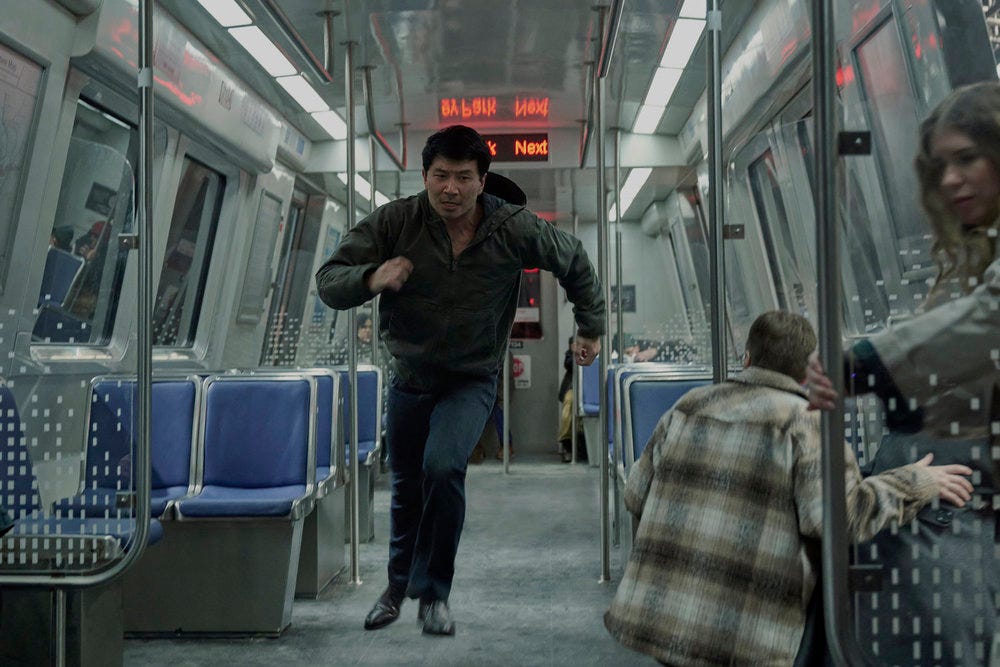
With all 8 episodes premiering Saturday, December 27, the series expertly threads espionage, philosophy, and emotional devastation into something that feels less like passive participation and more like consent to be watched. It’s tense, frighteningly plausible, and heartbreakingly human. At the center of it all is Alexander Hale—played by Simu Liu—who delivers some of the most vulnerable work of his career. Hale, a first-generation Chinese-American intelligence analyst, discovers the unthinkable: his brain has been hacked. Everything he sees. Everything he hears. His entire life accessible to someone else.
Hale finds that he is suddenly both asset and liability, weapon and target, victim and suspect—and he has to keep up a performance, a false version of his own life, if he is to survive.
How do you tell your story when someone else is already writing it for you?
A story within a story. A trap within a trap
The Copenhagen Test is that rare espionage thriller that moves like 3 styles at once:
a whodunnit
a howcatchem
a story about the story within the story itself
Think The Truman Show, if the dome was inside your skull.
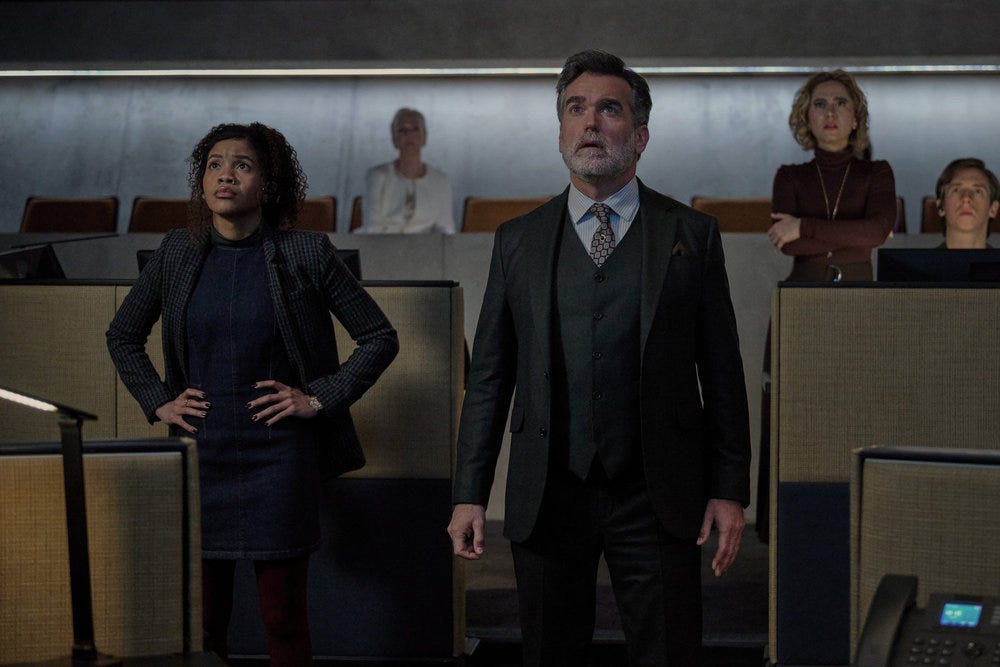
The narrative folds in on itself through Samantha Parker (Sinclair Daniel), a predictive analyst and former playwright whose job is to script the very life Hale is forced to live. She observes him, designs his cover, and tries not to collapse beneath the ethical weight of her participation. As Parker attempts to take an observer's point of view, Michelle, played by Melissa Barrera, refuses to let her hide behind technicalities.
Just because you didn’t pull the trigger doesn’t mean you didn’t cause destruction.
The show turns the writers’ room into a moral battleground. Who is responsible—the observer, the architect, or the person forced to perform the life chosen for them?

Schrödinger’s Cat—the science beneath the dread
The series’ title nods to the Copenhagen interpretation of quantum mechanics—Schrödinger’s cat, the idea that observation itself collapses possibility into reality. The moment you look at something, you change it. And in Hales’s world, observation is not passive; it is a weapon.
Hale’s sudden predicament centers around advanced nanotechnology that binds to brain cells, creating a symbiosis that turns a human being into a live broadcast. Every sightline. Every conversation. Every betrayal forming in real time.
He is the weight that can tip the scales—and he never asked to be.
Simu Liu is the emotional nucleus with a performance that is, simply put, devastating. His Alexander is brilliant, terrified, angry, and exhausted in a way that is bone-deep. It’s not the panic of being chased nor the betrayal of being lied to—it’s the grief of realizing his free will was never actually his to make but a fictionalized version of his real life filtered through someone else’s imagination.
The ensemble is also electric around him, anchoring the story in its self-imposed chaos:
Sinclair Daniel as Samantha Parker—sharp, conflicted, heartbreakingly human
Melissa Barrera as Michelle—grounded, fiery, controlled, resolved
Adina Porter as Marlow/Brian D’Arcy James as Moira—chilling, controlled, authoritative
Kathleen Chalfant as St. George—power, presence, unwavering
The chemistry across the cast doesn’t just support the plot—it detonates it.
A thriller that won’t let you look away—even when you want to
The Copenhagen Test is jam-packed and high-octane, but it never forgets its characters. Beneath the surveillance and questionable morality, the story is about real human concerns: autonomy, identity, revenge, grief, and purpose.
But don’t get too comfortable. The finale doesn’t tie a bow on anything. It widens the lens. It asks important questions: who else is being used, how many lives are being rewritten, and can anything ever be “over” for people in this line of work?
Call it espionage. Call it sci-fi. Call it a warning wrapped in a love letter to human agency. Whatever you call it, be sure to also call it a damn good show.
The Copenhagen Test is available to stream now on Peacock. Check out the trailer below.