

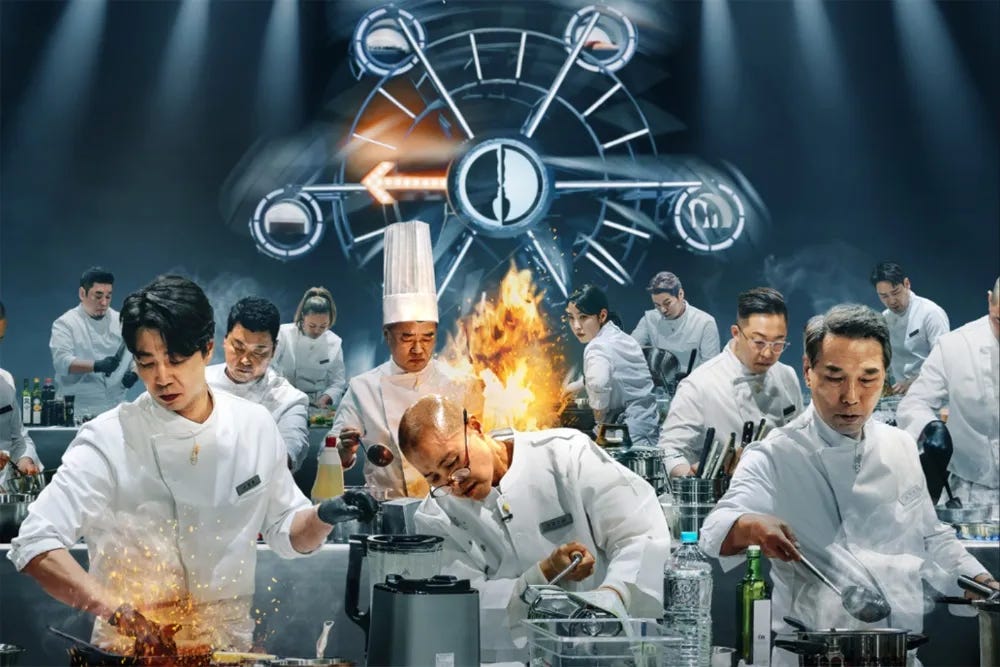
There are cooking shows you put on in the background. And then there is Culinary Class Wars—a series that demands your undivided attention, your emotional stability, and at least one moment where you pause the episode just to breathe. Culinary Class Wars—a Korean food competition show—is the most stressful, addictive food competition on Netflix—and Season 2 turns the heat all the way up.
For a culinary show, it feels less like a battle of skill and more like a prolonged stress test: for the contestants, the judges, and the audience. Each season runs 13 episodes, released 2-3 episodes per week, which means the tension doesn’t reset—it compounds. You finish one episode already anxious for the next, only to discover the stakes somehow get worse.
The premise is deceptively simple:
White Spoons—elite, globally recognized chefs—versus Black Spoons, lesser-known cooks whose reputations come from local communities, viral moments, or years of quiet mastery. The show frames it as prestige versus proof. What unfolds is something far more emotional.


Prestige meets purpose
Season 1 launched with 100 chefs entering the arena, immediately throwing them into brutal culinary duels that tested creativity, speed, technique, and resilience. Judges Paik Jong-won and Ahn Sung-jae (of Mosu Seoul), oversaw the chaos with an exacting eye, guiding the competition toward a final showdown that crowned a Black Spoon winner, who took home the prize of 300 million won.
Season 1’s victory was more than a win—it was a statement. Black Spoon chefs, many specializing in street food and comfort cuisine, proved that innovation and excellence don’t belong exclusively to fine dining rooms. Winner Kwon Sung-jun, better known by his self-chosen moniker Napoli Mafia, embodied the spirit of the show: confidence earned through craft, not credentials.
No one is safe—not even the rules
Season 2 doesn’t just raise the stakes. It rebuilds the game entirely.
Every challenge—including the initial elimination round—is redesigned so that chefs who watched Season 1 can’t anticipate criteria, strategy, or judging logic. The result? A competition that’s as much psychological warfare as it is culinary excellence.
What changes everything this season is the talent pool. Many Black Spoon chefs could easily pass as White Spoons—Michelin-level skills, decades of experience, and deep technical mastery. Meanwhile, the White Spoons arrive without the arrogance that lingered in Season 1. Some recognize their competitors as former students, mentees, or peers.
The tension shifts from us versus them to everyone deserves this.


Why this show stands above the rest
Part of what makes Culinary Class Wars so brutal—and so compelling—is its commitment to fairness. The judges don’t know the grading criteria until the challenge begins. That single choice eliminates bias on a structural level and forces Paik Jong-won and Ahn Sung-jae to judge outside their personal culinary preferences.
It’s harder. It’s riskier. And it makes every decision feel consequential.
Season 2 leans fully into the love of cooking itself. Among the competitors are:
a monk
a chef with almost 60 years of experience
Michelin star Chinese and Korean cuisine masters
Self-taught fine dining chefs
People who shifted from a career of science and education to cooking
By the time you reach later episodes, you’re not rooting against anyone. You’re rooting for everyone—which somehow makes each elimination worse.
Final take (spoiler-free, because I care)
I won’t spoil the finale. You deserve to feel the stress the way the rest of us did.
What I will say is this: Culinary Class Wars might be the cooking show to end all cooking shows. It’s rigorous, emotional, unpredictable, and deeply respectful of its contestants. It celebrates Korean cuisine while dismantling assumptions about hierarch, prestige, and what makes a “real” chef.
Watching it, I genuinely wondered whether Chef Slowik from The Menu would thrive here…
Clear your schedule and stream Culinary Class Wars now on Netflix. You’re going to need all the free time you can get with this one.
Check out the trailer below.