


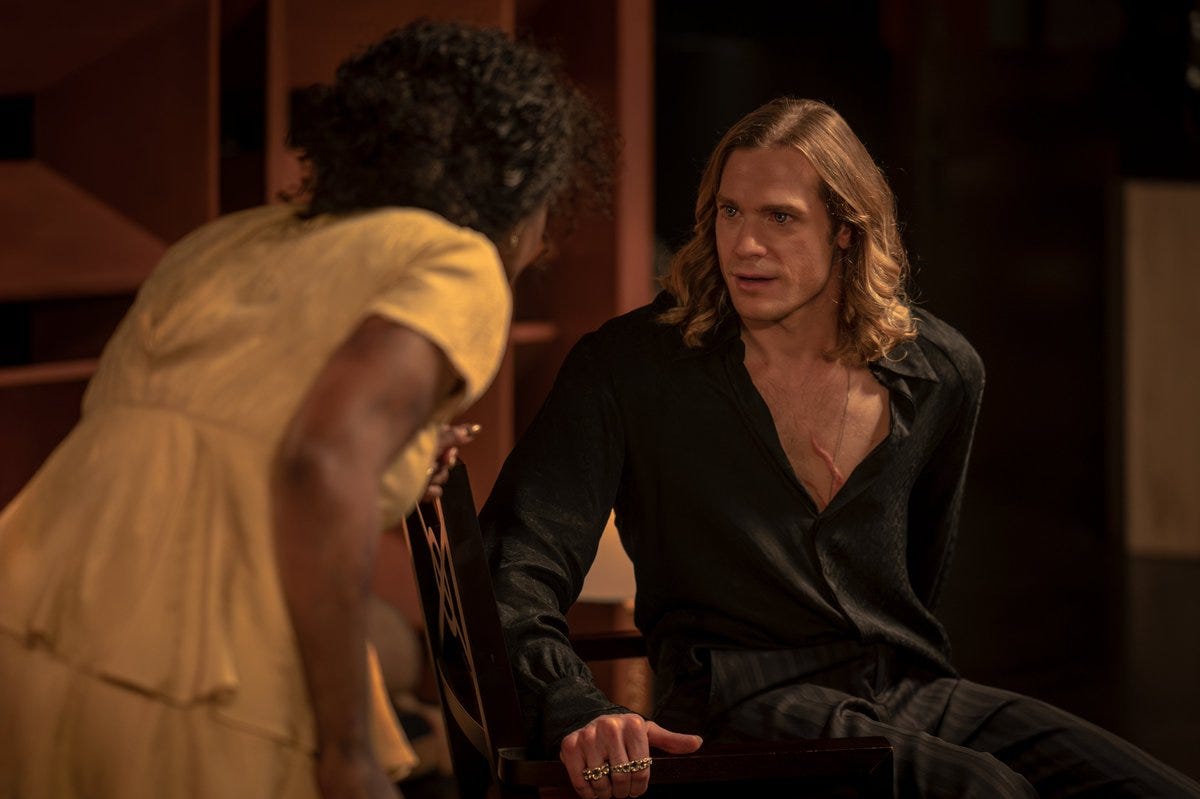
Throughout the two seasons of AMC’s Interview With the Vampire, audiences watched a young Claudia transform from innocent and inquisitive fledgling to a formidable vampire capable of great guile and artful finesse.
A product of her environment, she possessed the greatest weapons from both her fathers:
Her ire and her lethal tongue.
And in Episode 6 of The Vampire Lestat, “Montreal,” she harnessed both weapons, aiming them in a way that left no room for misinterpretation.
She was shrewd.
She was merciless.
She was devastating.
But for Lestat, she was spell-binding.
She was beatific rage.
And he did not want her cruelty to end.
Every cutting word, every lashing, and every ounce of vitriol aimed at Lestat and Louis wasn’t something Lestat simply endured.
He admired her. He encouraged and coaxed her anger, begging for more.


The Fragile Line Between Rage and Emotional Freedom
Since the moment Gabriella came back into Lestat’s life, he’s spent the entire time editing his emotions and suffocating his trauma to bend to her will.
As it was in mortality and now immortality, after every abandonment, he softens himself into a bundle of hope that one day she’d return maternal affection—compromising his true feelings for her proximity.
But Claudia refuses to compromise.
She refuses silence.
She refuses to bend to the will of absolving her greatest tormentors from their contribution to her pain.
And where Louis makes the mistake of trying to mold her into something more emotionally digestible to ease his own guilt, Lestat watches.
He invites her to cause his emotional ruin, his prideful smile adding oil to her flames.
He watches her take her freedom back through her words, hurling her hurt and anger at him, knowing that every insult is the very thing he deserves.
It’s also the very thing he wishes he could speak to those who failed him the most.
In death, she knows exactly who she is and what she deserves, even if no one else sees her for who she truly is.
And in the séance, Claudia’s truth becomes a reflection of the courage Lestat never found within himself and would have never found without her.
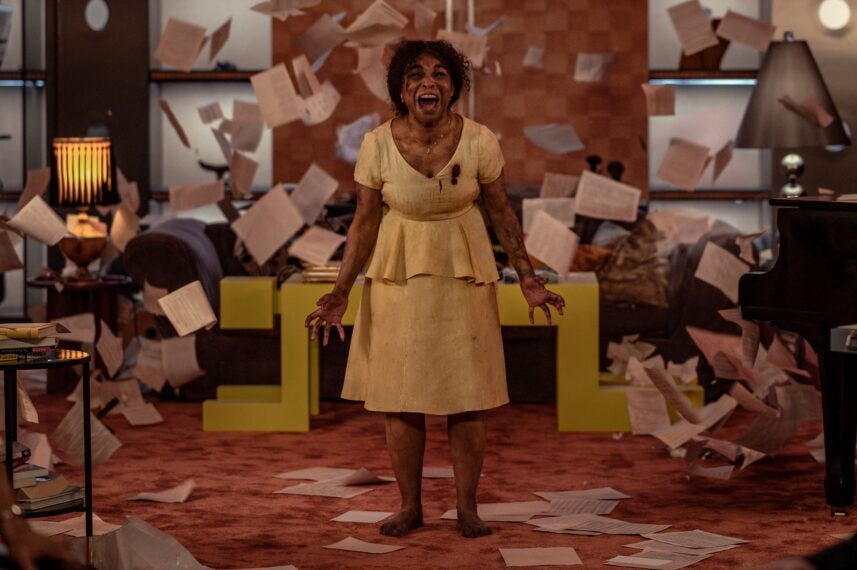
Claudia’s Reckoning Becomes Lestat’s Liberation
From “Detroit” to “Montreal,” Lestat struggles to separate the truth of his traumatic life from the performance he’s perfected in order to hide it.
But little by little audiences watched the mask slip—the songs became a confession, memories bursting forth from the pressure of centuries-long suppression, spilling over in melodies long before Lestat was able to sing the right words.
Yet Claudia never required another outlet. She just needed her fathers to finally listen.
And sitting at the edge of the spiritual boundary, Lestat was finally forced to do so.
Claudia spoke without apology.
She spoke without requesting permission for her pain to enter the room.
She spoke without concern as to whether or not he could handle her rage as a parent.
His feelings did not matter.
And, ironically, Claudia’s demand became what Lestat needed to see, showing him what true emotional freedom looks like.
For the first time in his life, someone says the very things he spent a lifetime justifying. In this space, in this room, Claudia’s rage blooms beyond rebellion and hatred.
It becomes her liberation.
And watching it, hearing it, feeling it carves a space, should he choose, for Lestat to finally confront Gabriella with his rage in order to find his own freedom.
Lestat’s Narrative Journey
Kivonshe—founder of So There’s That—is a film & TV critic who explores compelling storytelling, fandom relationships, character psychology, and the impact of entertainment media through film reviews, episodic recaps, and in-depth theme analysis.