

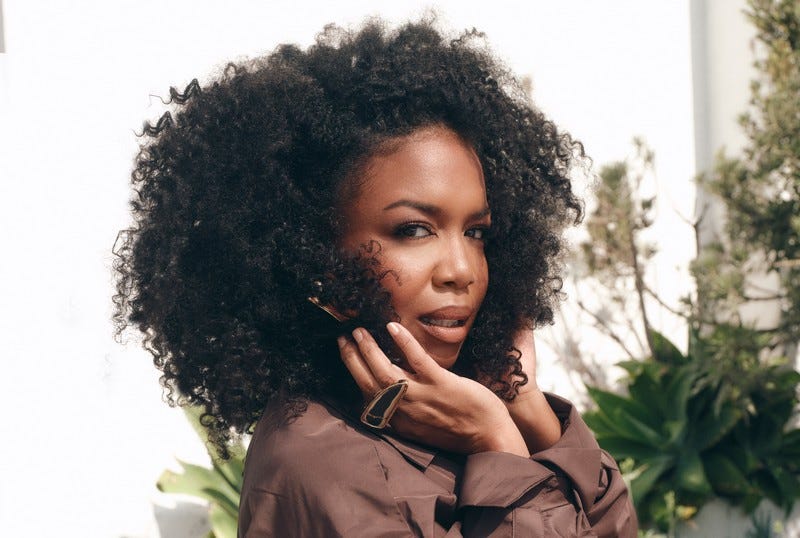
It’s early afternoon on a Thursday as I am waiting for Jessica to arrive on Zoom.
Suddenly, she enters with a bright smile and fresh box braids, and we immediately fall into how electronics fail you at the worst possible moments.
It’s easy between us, and the conversation ahead was long overdue.
My relationship with Jessica began in late 2024 when Earth Abides premiered on MGM+. What started as weekly interactions on the internet through the fandom developed into a sisterhood that extended beyond the credits.
But before our interview can officially begin, Jessica tells me she’s been waiting for this interview, too—watching me not only champion shows she’s been a part of but the arts as a whole.
Over time, mutual professional admiration became something warmer and welcoming. So when I introduce her as someone I admire and hope to call “friend,” she replies,
“You already are my friend.”
Immediately, the interview feels less like an interview and more of a conversation between two friends who like talking about the strange, terrifying, and beautiful journey of being an artist.
The Breakthrough Is At Every ‘Yes’
Before Maya from Ozark.
Before Emma from Earth Abides.
Before Athena Trumbo from The Gilded Age.
Even before Birdie Polk from The Westies.
There was one artist that served as Jessica’s North Star.
Michael Jackson.
I ask her to go back to the performer or performance that solidified her choice to pursue acting, and without hesitation, she mentions Michael.
Jessica explains that Michael was the first artist to leave her starstruck—not solely for his ability to perform, but for his ability to command a massive audience.
His artistry extends beyond the stage, and it imparted a single declaration from young Jessica.
“I knew I wanted to be an artist [from day one].”
Like many dreams, hers evolved over time.
First, the artist emerged with a Broadway career.
Sing. Dance. Act.
Tell stories that leave audience members in awe and in conversation for days, weeks, or years after the performance.
But what followed was a theater career that taught Jessica a lesson that proves something even greater:
There is no singular moment when an artist suddenly becomes worthy of being seen.
There was worth before Birdie.
There was worth before Emma.
There was even worthiness before Maya, a role that many viewers would proclaim as Jessica’s breakout role.
Before what the mainstream would call breakthroughs, there was Spunk in Washington, D.C. There was Robert O’Hara’s Bootycandy and Lynn Nottage’s By The Way, Meet Vera Stark—the very performance that paved the way for Jessica to exist within the Ozark universe.
“Every character is an opportunity to break through.”
It’s such a deceptively simple philosophy for an industry that can become obsessed with artists waiting for permission to believe they’ve made it.
The breakthrough doesn’t have to be a moment.
Maybe it’s a culmination of many small moments that are evidence enough to realize you’ve already made it.
Characters and the Gifts They Leave Behind
One misconception about actors is that they have a unique ability to lie since they’re able to “play” characters on stage or on screen.
What actually occurs is the actor gets to know the character they will embody in order to tell their truth.
And there is a cost to creating and embodying these women.
Jessica doesn’t just “play” them—she speaks about them as whole beings she temporarily inhabits.
People who inevitably leave something behind.
“I’m never the same person before a role and after.”
That sentiment is profoundly clear when we begin to speak about Emma.
In MGM+’s Earth Abides, Jessica plays Emma, a woman in a post-apocalyptic world who shows up on our screens in a way that tells the audience exactly the type of survivor she is.
But Emma also came with something that is rarely seen in women characters.
She displayed great strength, yet never hid her vulnerability.
She was maternal without being relegated to the role of just being a mother.
Emma was also extremely resilient and emotionally present, even while grieving the life that was taken away from her.
For Jessica, the fully realized life and experiences of Emma meant going deeper than what was written on the page.
But when it was time to say goodbye, her experiences from Earth Abides left room for Jessica to share her life with a new character that was completely unlike Emma.
After finishing an emotionally demanding series on a Friday, Jessica found herself in corsets and bustles as Athena Trumbo by the following Tuesday.
However, Jessica openly delights in the change of scenery, energy, and the emotional arena that Athena afforded her.
“I needed joy. I needed to laugh. I needed to be fun.”
In portraying a Black woman thriving in the elite society in the late 1800s, Jessica found echoes of her own family’s history.
She thought about the women in her family and the way her grandmother shifted the energy upon entering every room.
Athena then became more than just a departure from Emma’s pain.
She became an homage to Jessica’s own family legacy.


All The Places She Will Go
And then there was Birdie.
The Westies places Jessica in the heart of the grimy and dangerous 1980s New York, surrounded by crime, broken loyalties, and men who underestimate the power of the women around them.
Is she another federal agent? Yes.
But Birdie is no Maya.
Yet through her many roles she’s chosen, a clear pattern takes shape.
Each woman is intelligent, certain, commanding, and fully realized—foundational characteristics that are extremely important to Jessica.
And she speaks about the differences in navigating each woman—existing inside their worlds long enough to tell their stories.
All of them gave her that.
Now, Jessica is hungry for more.
As our conversation moves toward roles she would love to bring to life on stage and on screen, Jessica immediately allows her imagination to fill the space.
Fantasy.
Magic.
The kinds of expansive fantasy stories where Black women have only been allowed to support but never be the main event.
“I just believe us to be magical people.”
It’s a statement that reveals more about Jessica than the question itself—showcasing how she isn’t interested in only occupying spaces that already exist.
She’s already building an architectural foundation for the spaces that don’t.
Jessica tells me she has at least six scripts in the queue—those she’s written for herself, friends, and some just because the story itself demanded to be told.
But after a year of back-to-back productions, she’s finally allowing herself the thing many artists take for granted:
Rest.
A beach, some sand, and some much-needed time in the sun.
This doesn’t mean the work stops.
The scripts remain.
The ideas tremor in excitement at turning into fully realized stories.
Perhaps that energy is exactly why “breakthrough” never feels like it fits in Jessica’s world.
It implies there’s something blocking you from the next achievement.
Not for Jessica.
She sees a wall—another woman, another world—and she simply walks through it.
Watch my full conversation with Jessica Frances Dukes below, or listen to the interview on Spotify, Apple Podcasts, and Amazon Music.
For more articles, interviews, reviews, and more, subscribe to get them sent directly to your inbox.
Kivonshe—founder of So There’s That—is a film & TV critic who explores compelling storytelling, fandom relationships, character psychology, and the impact of entertainment media through film reviews, episodic recaps, and in-depth theme analysis.
© Kivonshe | So There’s That
Original editorial commentary on film and television. All rights reserved. Reproduction or redistribution without attribution is not permitted.