



Sheepdog arrives quietly. That is its power.
Set to open in theaters nationwide Friday, January 16, 2026—after a limited release in December 2025—Steven Grayhm’s long-gestating film does not announce itself with spectacle or cinematic bravado. It doesn’t boast of its impact with heavy action or artillery. Instead, Sheepdog asks the audience to sit, put the phones down, and live with the characters long enough to experience this moment of their lives. Not just the trauma—but the unseen war from within in its wake. Sit with the characters in the years after the uniforms are tucked away—to the places where meaning, guilt, love, and memory quietly, yet dangerously, collide.
Grayhm, who directs, writes, produces, and stars in the film, spent 14 years researching and developing Sheepdog. That level of diligence shows—not in excess, but in restraint. The film feels considered, weathered, and deeply intentional. It is less about what happened in combat, but about what lingers long after the weapons are put down.
At its center is Calvin Cole (Grayhm), a highly decorated former service member navigating life with post-traumatic stress disorder (PTSD), multiple traumatic brain injuries (TBI), and the emotional wreckage that seeps into every unseen crevice of his relationships with family and friends. His days are ordinary. His life quiet. Until inner demons surface like a volcanic eruption in circumstances the average civilian would consider a minor inconvenience. This mundanity, however, is not accidental. Grayhm made a deliberate choice to avoid the loudness of traditional warm-film aesthetics—instead focusing on the loudness of the dangerous thoughts within the mind and within the life of veterans.
There are no reenacted deployments for the audience. No kinetic battle sequences that make you jump back. Only silence.
“There was a version of Sheepdog that had three deployments,” Grayhm explains in an exclusive interview with host, Kivonshe. “But I was given some of the best advice I’ve ever received: if you don’t have the budget to shoot the action, don’t shoot the action. Keep your world honest.”
That honesty becomes the film’s defining feature. The camera doesn’t hover above Calvin’s life—it stays beside him like a battle buddy who promised to never leave their wingman behind. Kitchens, cars, waiting rooms, lived-in houses. These aren’t sets; they’re real spaces that hold the weight of the story being told. The effect is immediately immersive and quietly demanding. You don’t observe Calvin’s trauma from a safe distance. You’re in the thick of it with him.
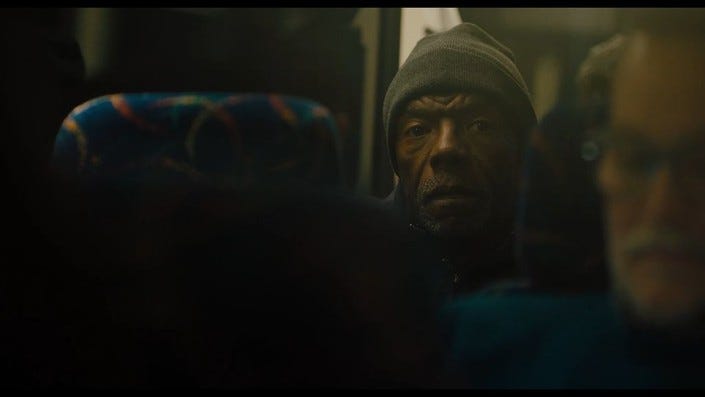
The title “sheepdog” refers to the metaphor often used to describe protectors—those trained to stand between danger and those vulnerable. But Grayhm complicates that idea, asking what happens to the sheepdog when the threat is gone, when the instinct to protect has nothing to ground it. This takes us into the emotional gray zone where purpose is eroded but the feeling of total responsibility remains.
“Sometimes we gotta fall apart to find ourselves all over again.”
One of the film’s most profound relationships emerges when Calvin crosses paths with Whitney St. Germain, played with remarkable depth and empathy by Vondie Curtis-Hall. Whitney is a Vietnam-era veteran recently released from prison after decades of incarceration, stripped of his medals and denied recognition as a veteran due to the technicalities of his discharge—despite decades of service to his country. His return to society is everything but triumphant.
It’s disorienting. It’s painful. It’s unfair.
Curtis-Hall brings an accumulated gravity to Whitney, a man shaped by a lifetime of systemic neglect and unresolved grief. “When I read the script, I was like, this is a journey I’d like to take,” he says. “I saw in this man so many people I grew up with. Folks who came home carrying wounds, folks who weren’t embraced.”
Whitney’s presence introduces another layer to Sheepdog: the ugly truth about how institutions fail to protect those who serve and protect them. While the film doesn’t turn the truth into a sermon, it doesn’t soften the blow either. And through Whitney, we see the result of decades of compounding trauma and how it manifests when ignored, criminalized, or dismissed altogether.


What Sheepdog does exceptionally well is resist flattening trauma into a single experience. Calvin and Whitney are bound by shared service and sacrifice—despite serving in two different wars—but their wounds manifest differently. One is burdened by unspeakable guilt while the other uses resilience as a lifeline for survival. Although they manage their demons differently, their bond grows—not from identical pain, but from recognition and acknowledgement of it. From seeing another person who understands the cost of carrying the burden of service alone.
The supporting cast—Matt Dallas (Darryl Sparks), Dominic Fumusa (Clarence ‘Coach O’ O’riordan), Virginia Madsen (Dr. Elecia Knox), and Lilli Cooper (Alice St. Germain)—further deepens the film’s emotional ecosystem. Dr. Elecia Knox (Madsen), a combat trauma specialist, brings an unexpectedly light, but unabashedly honest, touch to heavy material. She does not posture herself as an expert on trauma. Instead, she listens. She waits. Her approach—sometimes chastised by the system she works within—reflects one of the film’s softer refrains: presence can be more powerful than solutions.
At one point, she offers Calvin a deceptively simply idea: “if you can reach the boy, you can heal the man.” It is by no means a cure. Instead, she offers an invitation—to curiosity, to compassion, to the possibility of post-traumatic growth rather than mere existence. She offers him the act of reaching within himself, to take the scared boy by the hand, and walk with him instead of fighting to silence him.


Sheepdog is equally attentive to the collateral damage of PTSD through its impact on spouses, children, and friendships. The film is careful not to vilify their reaction to PTSD, but honors their pain too. These relationships are rendered with an empathy and complexity that only comes from those who experienced it. It is in these moments where Grayhm’s research shines. It shows that PTSD is not exclusionary—it includes and implodes everyone around it, highlighting the film’s commitment to truth over catharsis.
Ultimately, Sheepdog is a story of redemption—but not the glossy kind. It is ugly. It is painful. It is incremental. It is choosing to stay and listen, offering an even greater mission: to live for your country after being willing to die for it.
When asked why this story, why this way, Grayhm states he hasn’t seen this depiction before—who the heroes become decades after the war was fought. That perspective makes Sheepdog feel absolutely necessary. It doesn’t chase the adrenaline of war. It sits with the debris and the emotional shrapnel left behind in those who fought. It does not seek to answer questions. It simply lays it out for the audience to reflect, to live with—hoping to give them a better sense of what unimaginable grief and terror is carried by those who made it home.
In doing so, Sheepdog becomes something rare. It is a film that doesn’t ask for applause. It simply asks for your undivided attention. And for those willing to lend it, the reward is profound.
Sheepdog is in theaters everywhere Friday, January 16, 2026. Check out the trailer below.
© Kivonshe | So There’s That Podcast
Original editorial commentary on film and television. All rights reserved. Reproduction or redistribution without attribution is not permitted.