


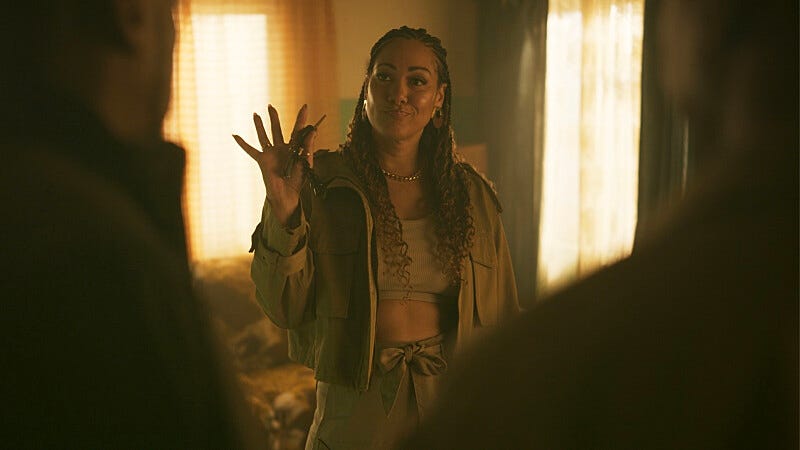
The Woman We Perceive
The saying goes, “There’s no woman like a woman scorned.”
But what happens when the scorn doesn’t present itself in open rage and destruction?
What if it’s quietly brewing during years of being wronged?
And when it finally comes to light, it isn’t explosive but calculating and self-protective.
What if the scorn looks like something you can’t stand to face because facing it would mean recognizing some parts of your life within the woman taking action?
These are questions that I pondered across two seasons of Average Joe when experiencing Cathy—a multidimensional and astoundingly dynamic woman who embodies everything we love and dislike in a person.
In women.
And judging by the way audiences react to the escalation of Cynthia Kaye McWilliams’ portrayal of Cathy in Average Joe, they don’t much like her.
McWilliams’ character consistently makes decisions that appear selfish from the outside looking in. But internally, Cathy is also a woman trying to have her voice heard in a world where the men around her often get the final say.
Even now, in Cape Town, Cathy is surrounded by Leon, Touch, and of course Joe—who often make decisions for the group that Cathy openly challenges, only to privately convince Leon that another plan may be better.
Her voice? Suppressed.
Her ideas? Discarded.
And it breeds a resentment that at first appears to be disloyalty but could come from years of feeling unheard and misunderstood.
For two seasons, the core group has been dodging danger across two continents, yet Cathy’s proposed plans have often proved correct after the men rejected them.
That is, after her ideas were shot down, something went wrong, and the men eventually came back around needing Cathy to bail them out.
It’s a cycle many women recognize: having the answer isn’t always enough when people believe you shouldn’t be the one that has it.
Even in a marriage where her husband built a pedestal on his back for her to stand on, Leon questions the validity of her ideas in front of his friends. And with every dismissal and Leon’s wavering support, something between them fractures a little more.
So for a woman on screen who, by all accounts, looks like nothing will ever be enough for her, it’s true.
But it’s not the money or the drugs that aren’t enough.
There’s never going to be enough apologies to fill the emptiness she’s been left with time and time again whenever she was told and shown that her voice didn’t matter.


The Woman They Perceive
In Season 2 Episode 6, “Blind Spot,” this ire comes fully forward as Cathy betrays the group and offers Joe to Sipho in exchange for money and freedom.
It’s also in “Blind Spot” that Joe discloses the secret that Leon lied about being sterile and that it was Cathy who was infertile—mocking her for being unfit to be a mother.
This is information that causes her deep harm, as flashbacks in Season 1 show a brighter, more hopeful Cathy crumble under the weight of feeling “broken” because she couldn’t get pregnant.
For Cathy, the inability to have a child becomes more than infertility. Season 1 shows how deeply she internalizes not becoming pregnant as a brokenness within herself—a perceived failure attached to the life she thought she and Leon would have.
And that pain becomes difficult to separate from the expectations women are taught to carry around motherhood—where the ability to become a mother can become entangled with ideas about womanhood, fulfillment, and worth.
So with Joe’s spiteful confession, Leon’s act of selflessness is now perceived as a wound to Cathy’s agency, further fracturing the trust and family she thought she built with Leon.
And although his decision proved he loved her enough to protect her from the news he knew would devastate her, he didn’t trust her enough to handle her own feelings about it.
In his attempt to shield her from pain, he took away her power to choose how she would have wanted to grieve the loss of motherhood in the first place.
Now, Joe weaponizes this information to further divide her from the group.
It’s Joe’s family.
Then there’s Cathy.
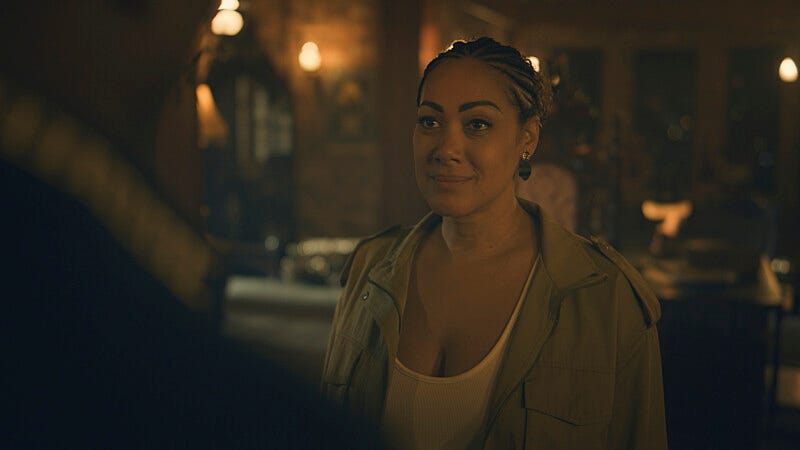
The Woman She Chooses to Be
So what makes Cathy’s anger so difficult to untangle?
She did everything society tells women to do—get married, try to start a family, build security.
All the things that are the alleged ingredients to a life that’s supposed to lead somewhere.
But little by little, the life she thought she was building became something she no longer recognized.
A life for which she was no longer willing to settle.
The easy thing to do is categorize all of her actions as selfish, but underneath them is a Black woman with rage.
A Black woman with grief.
A quiet rage that built over years of being let down.
Years of being silenced.
Years of seeing what life could be all for the possibilities to vanish before her eyes.
And years of grieving the discrepancy between the life promised by doing everything “right” and the life she actually received.
So when following the “right path” gets her nowhere, the opportunity to start over—by legal or illegal means—is attractive enough for her to go into self-preservation mode.
But self-preservation has a cost.
The cost?
Cathy making the same decisions for the group that she herself resents.
Her freedom now comes at the expense of Joe, Touch, and Leon.
Her survival requires someone else to become collateral.
And that’s where Cathy’s actions become difficult to defend even when she remains easy to understand.
Maybe that’s the uncomfortable line Cathy has been walking all along.
After spending years believing everyone else’s needs, decisions, and futures came before hers, choosing herself begins to feel less like betrayal and more like survival.
And for Cathy, survival begins to require the sacrifice of everyone around her, which makes it difficult to tell where self-preservation ends and selfishness begins.
She loves Leon.
It’s been apparent across two seasons.
But in Cape Town, love and survival are at war, and her life depends on every decision she makes.
And each decision she makes in pursuit of survival can make the audience believe she’s incapable of truly loving anyone else at all.
But she isn’t a woman who doesn’t love.
She’s just a woman who decided she loved herself just a little more.
Want more analysis about complex women characters? Subscribe now to get them sent directly to your inbox. Have a character you want analyzed? Leave a comment.
Average Joe’s Family Dynamic
Kivonshe—founder of So There’s That—is a film & TV critic who explores compelling storytelling, fandom relationships, character psychology, and the impact of entertainment media through film reviews, episodic recaps, and in-depth theme analysis.
© Kivonshe | So There’s That
Original editorial commentary on film and television. All rights reserved. Reproduction or redistribution without attribution is not permitted.