


What We Inherit to Survive
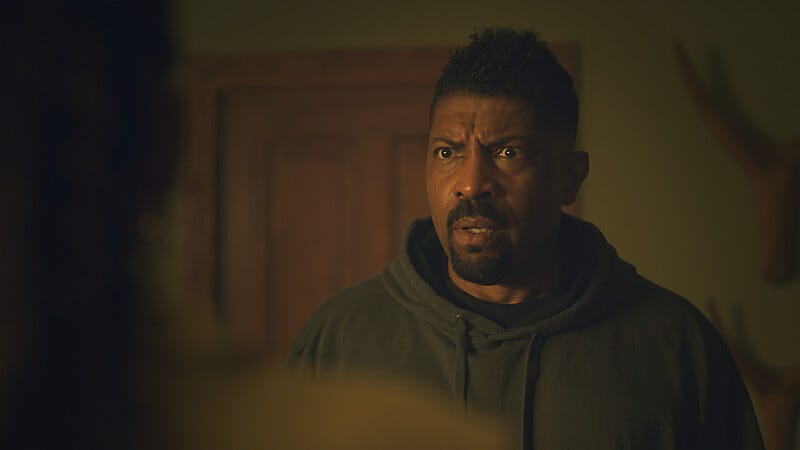
Average Joe Episode 5, “Keep It Together,” examines what people inherit from those who left them behind.
Survival instincts.
Guilt.
Grief.
And unhealed wounds.
All of these feelings collide at once as Joe must make a decision to either flee from the violent mess Teddy left behind or save Imani.
In a panicked and desperate attempt to save Imani from kidnappers, Joe makes the decision to risk everything to get her back.
And while Teddy may be a terrible father, both Joe and Imani show that it’s in their blood to do whatever it takes to survive—Imani even risking her own death just to avoid a fate far worse in the hands of Sipho.
“You’re my little sister now, and I got you.”
Average Joe shifts in energy as Joe wholly accepts Imani into his family and under his protection, but he’s fighting a war with a man whose murderous history extends back to when he was a boy.
Sipho didn’t just become powerful as a man. He witnessed destruction and power exchange as a child—surrounded by lifeless bodies and then coerced into taking another’s life.
A moment that seemed like Sipho would be recruited into a ruthless army, subject to being controlled for the rest of his life, quickly turned into a calculated execution by young Sipho—demonstrating that his survival instincts are more than primal.
They are decisions that shaped his life from victim to villain—enacting the very violence that he himself couldn’t escape.
But darkness falls, and the shadow swiftly approaches the line the Afghan queenpin drew on the wood of his compound with her deadly heel and even deadlier threat.
As time runs out, the $45 million debt now pales in comparison to the consequences that loom over his mortality.
And the man who built an empire of instilling fear now faces the threat of collapse under the weight of his own fateful decision in trusting Teddy.
Inheriting the price on the head of a dead man—a man whose past actions dictate the outcome of everyone else’s survival.


What We Must Let Go to Be Free
But something deeper is occurring between Phyllis and Touch—the spiritual restlessness that has her reaching for him as he pulls away.
Imani’s kidnapping and Jamila’s death send Phyllis into a spiral that, ironically, Touch saves her from. This creates the space for her to speak about her other sister, Mandipa.
The first one she couldn’t save.
The one who suffered from the same affliction that Phyllis recognizes in Touch.
“If you let me die…”
“…I let her die all over again.”
This revelation and Touch’s plea to be saved ignites Phyllis to go on a spiritual quest to remove the weight that cripples him, hurtling him toward death at every turn.
Her quest leads directly to Donna—the girl who shot and killed her mom.
A death that Touch covered up due to his negligence.
But it isn’t guilt that binds him.
It’s the lie that won’t let him rest.
The journey isn’t just for Touch, as Donna alerts her to a spiritual gift of her own that awaits.
Jamila and Mandipa.
Although Phyllis couldn’t save her sisters in life, they may prove to be the very power she needs to save Phyllis and her new family from death.
The lie can no longer stand.
Touch finally tells Joe and Leon about his suicide attempt—why he’s been on a mission toward that end for the past two months.
This confession brings the group closer together as they continue to work to evade Sipho, the cops, and get out of the country alive.
And as old wounds are tended and forgiveness is granted, brotherhood and banter make an appearance once again—showing how these men can confess something devastating, reconnect, and make us laugh even as they face their own destruction.
But just as the men come up with a plan to secure their escape, Cathy orchestrates a plan that could lead to their potential end.
Suddenly, nothing is a laughing matter anymore.
Average Joe’s Inheritance
Kivonshe—founder of So There’s That—is a film & TV critic who explores compelling storytelling, fandom relationships, character psychology, and the impact of entertainment media through film reviews, episodic recaps, and in-depth theme analysis.
© Kivonshe | So There’s That
Original editorial commentary on film and television. All rights reserved. Reproduction or redistribution without attribution is not permitted.