

A Life Once Imagined
No one prepares you for what it looks like to continue living after losing the promise of a life you longed to meet.
And you never realize how much you’ve been surrounded by new life until you lose one of your own.
Sometimes the simplest words set off an internal alarm that echoes in your core like the beat of a drum.
A pounding beat that starts off distant then suddenly becomes a loud and unyielding thing that you can never escape.
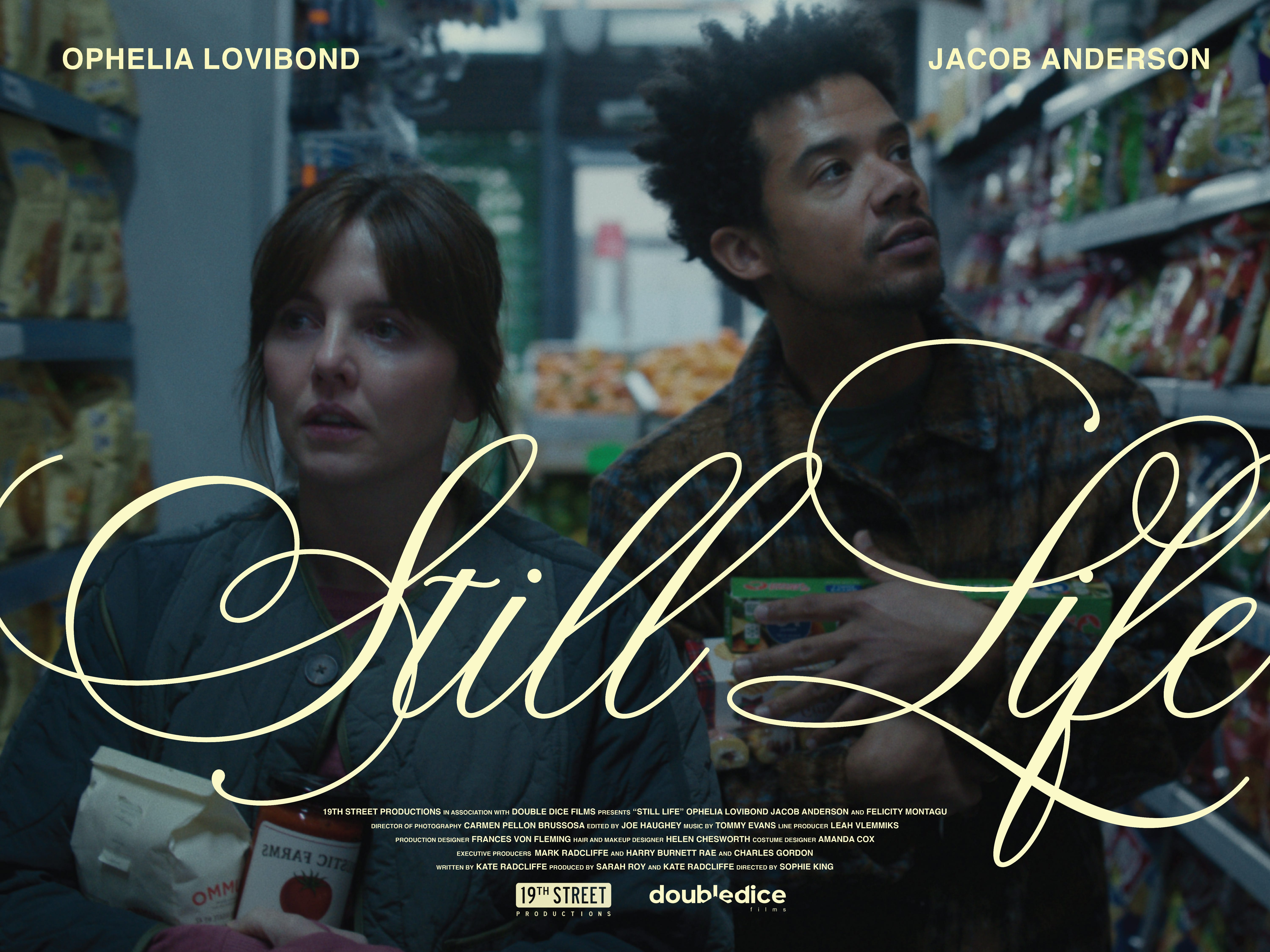
Still Life, a short film starring Jacob Anderson (Interview With the Vampire) as Max and Ophelia Lovibond (Minx) as Jess, explores the immediate aftermath of a couple struggling through daily life after suffering the loss of their child.
Written by Kate Radcliffe and directed by Sophie King, Still Life is incredibly honest in how it carefully examines the traumatic space losing a child leaves behind.


In eleven minutes, Still Life delivers a bone-chilling truth that highlights the joy, expectation, and subsequent grief of an expectant mother and an expectant father fighting to hold themselves—and each other—together.
This is where both Lovibond and Anderson shine as performers.
Lovibond carries the dark humor, awkward social interactions, and heartbreak like fine china on the edge of a coffee table as Jess attempts to resume her normal life.
She represents strength and fragility—the parts of grief that allow you to both move forward and fall apart at any moment.
Then there’s Anderson, who delivers a quiet kind of pain—the one where society imposes how a father is supposed to mourn loss.
Be a rock.
Be there for her.
But Anderson doesn’t allow the imposition to define Max. Instead, he shares emotional space with Jess, both of them present with the life they almost welcomed and the one that fell apart in front of them.
What makes Still Life especially powerful isn’t just how it explores loss, but how it shows the audience that mundane tasks and actions can trigger someone else’s greatest trauma.
Going for a walk.
Shopping.
Even going to the movies can become an unexpected reminder of what could have been and a stark reminder of what is not.
And Lovibond and Anderson carry the weight of this reminder beautifully.


Yet Still, Life Remains
Radcliffe pulls from her own experience with child loss, transforming something deeply personal into a story that gives language to an otherwise invisible grief that many families navigate silently.
Radcliffe and her co-producer Sarah Roy hope to use Still Life as a proof of concept for a potential television series, using the story to help amplify the voices and the lingering pain families feel when left to pick up the pieces of a life imagined.
But the hidden beauty in Still Life is in the name.
Still.
Life.
The film holds within it the possibilities of a life beyond loss.
A life that may be riddled with lows but is one that is still capable of holding great beauty.
And it’s in the unknown where something new can begin again. It doesn’t mean that you’ve moved on or will ever move on from what life could’ve been.
But it does mean that there is still more life ahead.
For more short film reviews, subscribe to get articles sent directly to your inbox. Have a short film you want analyzed? Leave a comment.
More Short Films to Explore
Kivonshe—founder of So There’s That—is a film & TV critic who explores compelling storytelling, fandom relationships, character psychology, and the impact of entertainment media through film reviews, episodic recaps, and in-depth theme analysis.
© Kivonshe | So There’s That
Original editorial commentary on film and television. All rights reserved. Reproduction or redistribution without attribution is not permitted.